


Osmosis Cleaning in Industry
How Cleaning Companies & Others Benefit
- Expert Knowledge
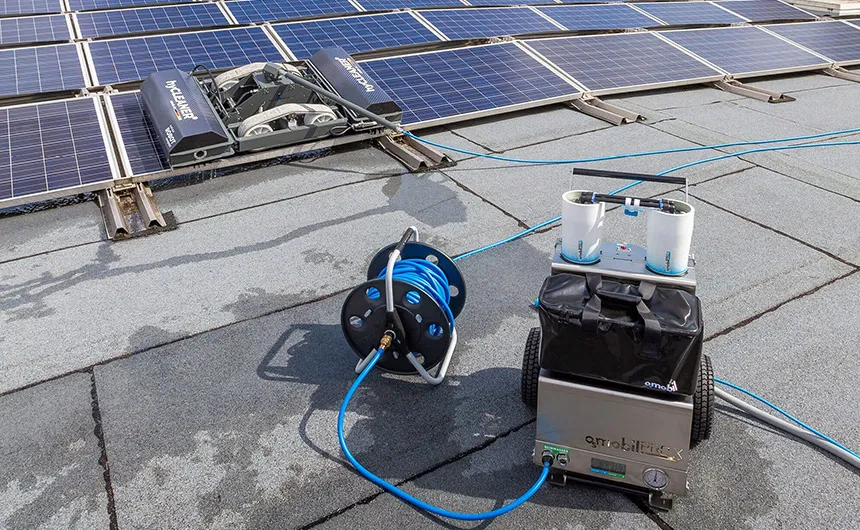
The environment, the health of cleaning personnel, and the costs of cleaning agents – the disadvantages of cleaning with chemical agents are numerous. However, a good alternative already exists. This is because osmosis cleaning exclusively uses treated water through a special filtration technology. In combination with an effective mechanical brush, the treated water enables environmentally friendly and efficient cleaning. How exactly does osmosis cleaning work, and how can companies best apply this method to clean PV modules, large glass surfaces such as glass roofs, and facades?
What is Osmosis Cleaning?
Osmosis cleaning uses treated tap water. This normally contains various minerals, limescale, and salts. When normal tap water evaporates, these components remain on the surface, for example, in the form of limescale stains. Even if these are very fine residues, they form a slight elevation where soot particles and dust can adhere. The result: The cleaned surface gets dirty faster and needs to be cleaned again after a short period.
In osmosis cleaning, the water first passes through a special reverse osmosis filtration system, which purifies the water of these minute components. This prevents residues from forming upon evaporation, and the surface remains clean longer. At the same time, the cleaning power is so effective that aggressive cleaning agents containing silicones, synthetic abrasives, or acids become unnecessary.
How does osmosis function in water?
Whether cleaning is worthwhile depends on the losses incurred due to contamination. These losses must be proportionate to the cost of cleaning. This can be determined using a loss calculator.
Empirical data shows that losses between 8% and 30% are quickly reached depending on the location. For example, we observe approximately 12% contamination on many commercial roofs, and up to 30% in agriculture. Open spaces often show a better value of approximately 5–10% due to their location.
How does a reverse osmosis system work for osmosis cleaning?
When cleaning with so-called pure water (also known as osmosis water, technical water, or ultrapure water), reverse osmosis is used to work against this osmotic pressure. The goal: to produce water with as few minerals and salts as possible on one side, while these substances are flushed away on the other. To overcome the osmotic pressure, water is forced through this membrane at a minimum of 3 bar during reverse osmosis. The smaller water molecules can pass through, while the substances undesirable for cleaning are retained. The higher the tap water pressure, the purer the osmosis water will be in the end.
How often should a solar system be cleaned? The influence of location and tilt angle
In osmosis cleaning, regular tap water is treated. The water quality is measured in ppm and influences the system settings. In Germany, water hardness ranges between 70 ppm (very soft water) and approximately 500 ppm (very hard water). For osmosis cleaning, a value below 30 ppm is required for facades and solar panels, and a value below 15 ppm for glass.
Water quality varies by country, meaning no universally applicable settings for the osmosis machine exist to achieve these values. However, for the filtration system to operate as intended, the use of normal tap water is necessary. Well water or water from similar sources is often too contaminated and thus quickly clogs the filter.
Osmosis Cleaning with Reverse Osmosis vs. Osmosis with Mixed-Bed Resin – Which is better in the long run?
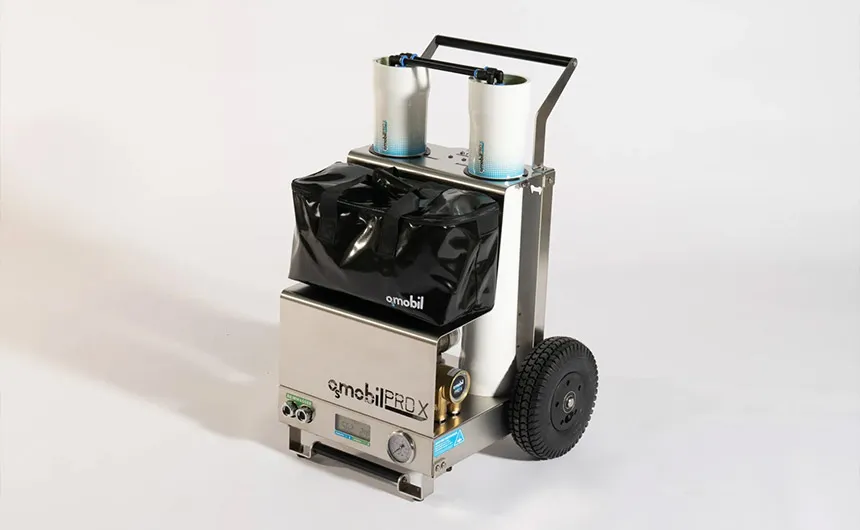
In addition to reverse osmosis, mixed-bed resin filters offer the possibility of producing pure water. While these are initially cheaper to purchase, the subsequent costs are considerably higher. While mixed-bed resin filters incur costs of €15 to €100 per 1,000 liters, depending on water hardness, the costs for cleaning with a
Due to the costs and practical application, a system with a mixed-bed resin filter is only suitable for small, sporadic jobs on systems up to 100 kWp with soft water, whereas an osmosis system operates effectively and efficiently even for large-scale projects.
Advantages of Osmosis Cleaning with Ultrapure Water
With osmosis cleaning using pure water, companies benefit from advantages regarding the occupational safety of cleaning personnel and cleaning costs, and this method is also significantly more sustainable for the environment.
Efficiency and Safety in Daily Work with Mechanical Cleaning
Many surfaces are not designed for high point loads. For example, large glass surfaces and many roofs often cannot be accessed for cleaning the glass surfaces themselves or PV systems due to occupational safety reasons. In such cases, a Cleaning robot that is placed on the roof from a work platform and remotely controlled. This is designed for the load-bearing capacity of roofs and similar structures, ensuring that cleaning can be carried out safely. Furthermore, a robot can also reach intricate surfaces, which are becoming more common due to advances in modern architecture and the development of construction methods.
Furthermore, a robot helps the company save financial resources. This is because, with the perfectly coordinated brush and the correct amount of water, it cleans not only effectively but also more efficiently compared to manual cleaning.
Simultaneously, the cleaning power is enhanced by the osmosis effect. The pure water absorbs particles more effectively because they tend to disperse due to osmotic pressure. There are hardly any foreign particles in the water, which is why the osmotic pressure here becomes particularly strong compared to the dirty surface.
Sustainable and Chemical-Free Cleaning for Health and the Environment
This also has a positive impact on the environment. Through efficient cleaning exclusively with water, no chemicals enter nature or wastewater, which would otherwise require extensive treatment. Simultaneously, the intervals until the next cleaning are extended, as dirt no longer adheres to limescale edges. This also saves resources and protects the environment.
In combination with mechanical cleaning, not only effective and efficient, but also sustainable and chemical-free cleaning is possible. It is not possible to generate sufficient pressure and brush rotation speed with a hand brush to remove stubborn dirt. In contrast, the cleaning robot ensures an optimal cleaning result through its high brush rotation and the precisely matched water quantity for an optimal cleaning result. In combination with osmosis water, surfaces are thus freed from difficult-to-dissolve dirt, while the water dries without leaving residues, thereby slowing down re-soiling.
Osmosis Cleaning with a Robot in Practice: 3 Examples
Pure water can generally be used to clean all smooth and closed surfaces that are found on glass facades, metal facades, and solar and PV systems. The following three examples illustrate how osmosis cleaning with a robot works in practice and how companies benefit from it.
Robots and Pure Water: Glass Cleaning for Roofs and More
Glass surfaces such as glass roofs or windows in large industrial halls are generally highly susceptible to dirt and maintenance-intensive, as contamination from weather, exhaust fumes, weathering, vegetation, bird droppings, and so on, quickly becomes visible. At the same time, cleaning is crucial to prevent material fatigue.
However, cleaning involves a high risk of accidents due to height, an increased risk of slipping on dirt and moisture, and modern architecture that complicates access. Furthermore, for multi-story and expansive buildings, unique building shapes, or sloped glass surfaces, osmosis cleaning with a telescopic pole is no longer feasible. This is because many roofs cannot be accessed, as this can lead to serious occupational accidents.
A robot, however, is adapted to the load-bearing capacity and structure of the buildings. The personnel operate the robot from the safe basket of a work platform. A hose supplies the robot with ultrapure water or tap water. Due to the cleaning properties of pure water and the efficiency of mechanical cleaning, the intervals until the glass needs to be cleaned again are extended. Therefore, osmosis cleaning by a robot improves occupational safety and reduces costs for materials and cleaning frequency.
Cleaning Photovoltaic Systems with Tap Water: Osmosis Cleaning via Robot
Photovoltaic systems are most efficient when clean, as stated by the Institute for Solar Research of the German Aerospace Center. However, they also get dirty from dust, sand, pollen, ammonia, leaves, or bird droppings. Therefore, they must be cleaned regularly to prevent significant yield losses. Especially for photovoltaic systems, cleaning with osmosis water and a robot is suitable, as the individual solar cells are very sensitive. Strong cleaning agents with acids or abrasives, hard brushes, or high-pressure cleaners can quickly cause damage here.
At the same time, conventional cleaning methods for large areas are very time-consuming, physically demanding, and uneconomical. Furthermore, for floating or roof-mounted systems, there is a high safety risk for cleaning personnel. Therefore, a robot is also a good solution to address these challenges.
Cleaning Facades: Why Osmosis Water is Suitable for Cleaning
Facades become contaminated primarily by verdigris, lichens, moss, or industrial pollutants. Regular cleaning enhances the external appearance and improves the longevity and value retention of the building. Depending on the material, many chemical cleaning agents are too aggressive and can damage the facade. The osmosis process cleans efficiently without chemical agents.
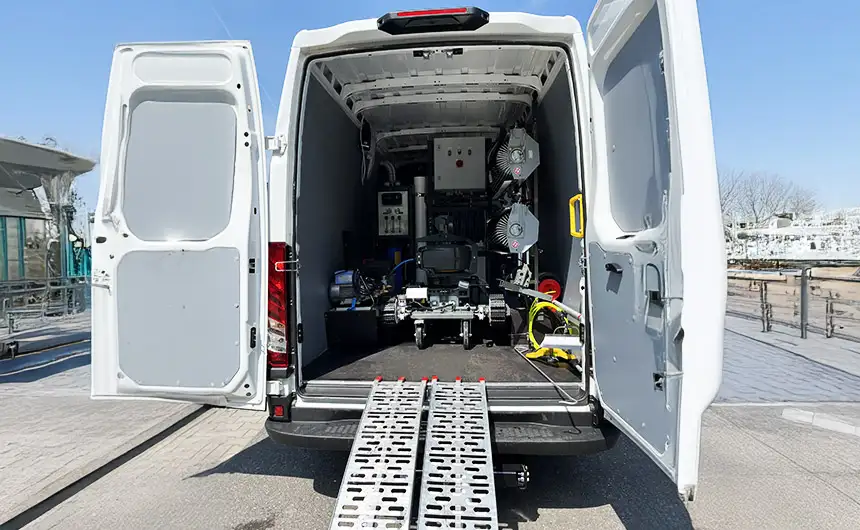
In combination with a facade brush, which is attached to and controlled from a work platform, large areas can be cleaned gently and efficiently at the same time. Therefore, it is also suitable for large shopping centers or furniture stores like Ikea, as well as other large buildings. Practical complete systems, as professional cleaning systems, combine the use of osmosis water and cleaning robots.
Efficient and Chemical-Free Cleaning through Osmosis Cleaning with Robots
The use of technical water, in combination with robot-assisted cleaning, is suitable for cleaning surfaces efficiently, effectively, and sustainably. This is because both techniques combine numerous advantages: Thanks to the high mechanical brush performance and the use of osmosis water, chemicals can be completely dispensed with. Furthermore, companies achieve the highest safety standards with the robot, as employees operate it safely from the basket of a work platform.
Would you like to learn more about the possibilities of a cleaning robot or osmosis cleaning? Then please contact us; we would be delighted to advise you!