

Cleaning Solar Panels – 5 Practical Tips
What You Should Consider When Cleaning Large-Scale PV Systems
- Expert Knowledge
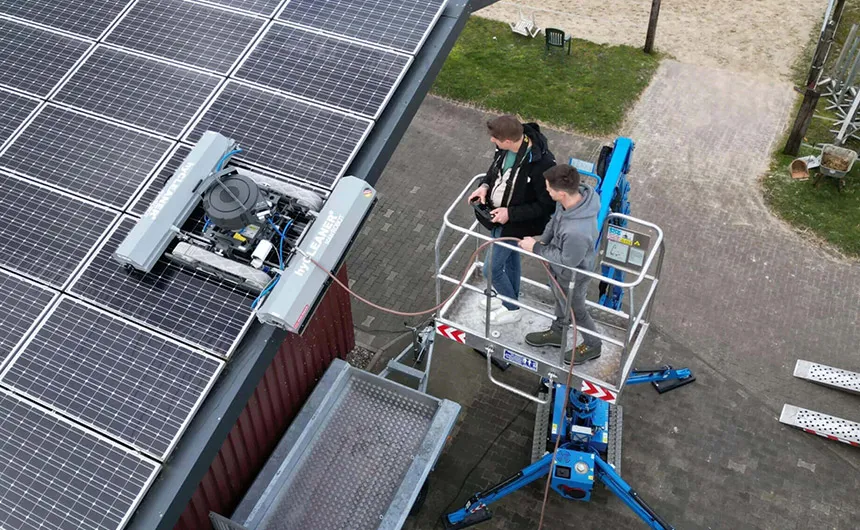
Clean solar panels for best yields – how and why to clean solar installations: Photovoltaics continue to enjoy great popularity in Germany, especially in industry. Alongside wind power, solar energy, with a share of 23.2% of electricity generation from renewable energies, is one of the biggest hopes for the energy transition. However, with the great potential of the technology, everyday questions also arise: How can solar panels of large-scale systems, e.g., on the roof, be cleaned efficiently and safely? What photovoltaic cleaning equipment is available? We explain the dos and don’ts of machine solar cleaning with robots.
How Often and With What Should You Clean a Solar Installation?
To function optimally, it makes sense for solar system operators to regularly clean their PV modules. Because: Contaminants such as bird droppings, grease, and rust dust negatively affect the performance of the modules. According to the Fraunhofer Institute, contamination can significantly reduce the maximum output of a PV system. This not only lowers the yield of self-generated solar energy but also reduces the potential feed-in into the power grid and the corresponding remuneration. How often a system actually needs to be cleaned using conventional cleaning aids or modern PV cleaning robots depends particularly on its location and the local precipitation. Especially in agricultural areas, a professional cleaning of solar installations at least once a year is recommended.
Which Cleaning Methods Are Suitable for Industrial Solar Cleaning?
Cleaning robots are indispensable in modern facility cleaning operations. The same applies to the cleaning of large PV systems. Here, solar cleaning robots particularly excel due to their high efficiency and environmental compatibility – because the high rotation of the brushes ensures an optimal cleaning effect without health-hazardous and environmentally harmful chemicals. Furthermore, if you clean with osmosis water instead of conventional water, the positive effect is maximized.
5 Tips – Cleaning Large Solar Installations: How to Do It Correctly
For the regular cleaning of the solar installation with the PV cleaning robot to be efficient and safe, several important points must be observed:
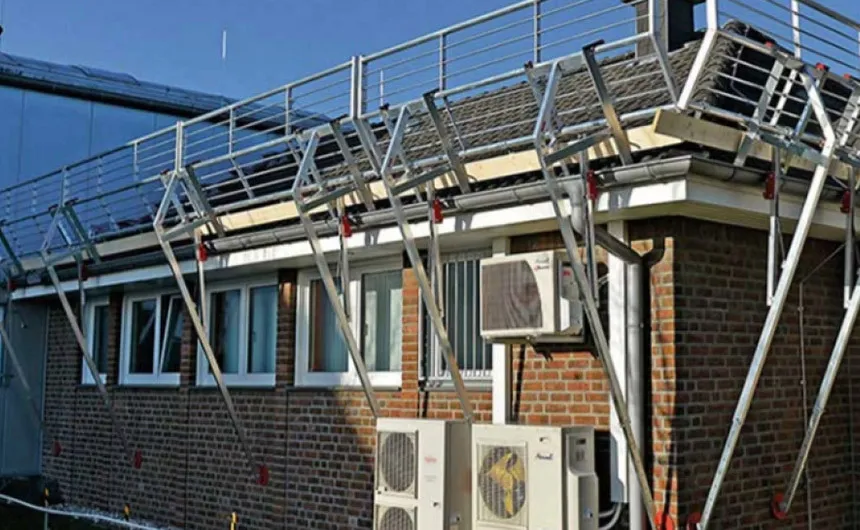
1. Safety First: Safely Bringing the Solar Cleaning Robot Onto the Roof
Safety is paramount when it comes to using robots for cleaning PV modules on the roof. Roofs, in particular, have individual requirements.
Generally: Cleaning should always be carried out by a professional and with the aid of climbing aids or, for example, ideally with ABS fall protection grids. The great advantage of solar cleaning robots – compared to manual cleaning of PV systems, e.g., with telescopic poles – is obvious: Cleaning personnel do not even have to enter the roof. Once the robot is placed on the roof and secured by ropes, it performs its job safely and reliably. Experienced cleaning personnel should always perform a visual inspection of the parts before commissioning and switch off the solar installation for the duration of the cleaning.
Good to know: hyCLEANER’s solar cleaning robots are equipped with fall protection sensors. This way, the robot detects the end of the solar surface early and can be steered in the opposite direction to optimally clean the solar installation.
Before use on the roof, a functional check of the cleaning robot, including edge detection, which currently only hyCLEANER offers, is important: Watch our video on this.
2. Adjusting the Cleaning Behavior to the Surface and Cleaning the Solar Installation Correctly
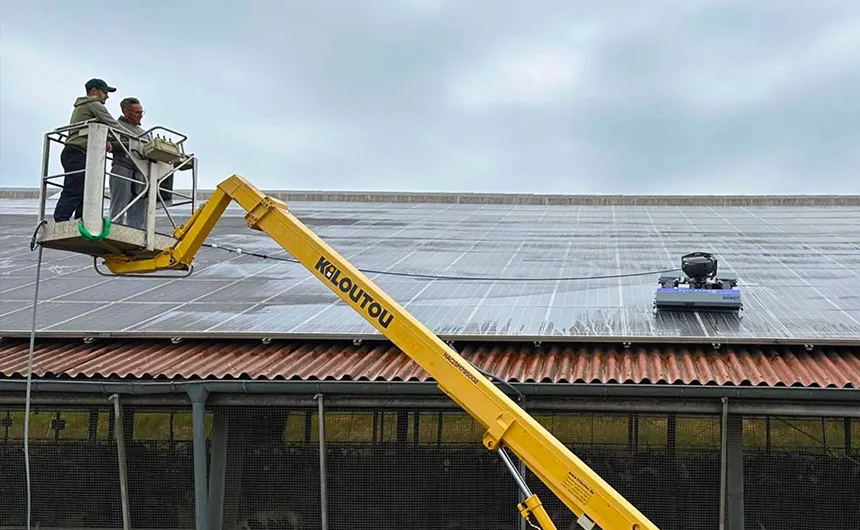
Depending on how heavily soiled a surface is and how steep the inclination angle is, the cleaning behavior of the machine must be adjusted. This includes, on the one hand, securing the robot with ropes, but also using the correct treads is important. For example, in the case of heavy ammonia-containing contamination (e.g., on cow sheds), it is recommended to use rubber treads.
Good to know: hyCLEANER offers three different treads – leather, rubber, or neoprene – included as accessories for various applications and surface requirements. They can be easily exchanged using Velcro fasteners.

3. Pre-cleaning: Consider Grip and Inclination Angle Before Cleaning the Solar Installation
The solar cleaning robots are driven by two chain-driven chassis, similar to snow groomers, providing them with the necessary grip on slippery, sometimes steep surfaces. Similar to car tire compounds for winter and summer, hyCLEANER’s cleaning robots offer different types of treads that you can easily change via Velcro, depending on the area of application:
- one specifically for dry cleaning, e.g., in desert regions
- one for normal contamination (with a climbing ability of up to 25° depending on the machine model)
- one that is specifically used for cleaning very dirty surfaces, such as cow sheds
Correct handling of the treads is essential to ensure the necessary grip. Therefore, pre-cleaning one to two panels before placing the robot on them is always recommended (see also next point). For the best possible grip, it is also advisable to pay attention to the hose routing from above. This prevents the load from pulling downwards and making contact with the surface difficult.
Also important: Before cleaning, the roof’s inclination should be checked with a measuring device, and the surface conditions should be correctly assessed. Depending on the model and the surface condition of the area to be cleaned, hyCLEANER’s cleaning robots are suitable for surfaces with inclinations of up to 25° (47%).
4. Observe Water Pressure and Water Quantity
For a maximum cleaning effect, pre- and main cleaning with water is recommended. Osmosis water is particularly well suited for both processes. This filtered water, from which salts, minerals, and other impurities are removed beforehand, is very gentle in cleaning – yet highly effective. For gentle and successful cleaning, it is essential to ensure a sufficient amount of water. Because: The less water used, the more likely it is that dirt will rub on the collector surface. This means the flushing effect for dissolving dirt is missing, so the same areas have to be cleaned multiple times. Solar robots work with low pressure. Therefore, they do not need much water pressure. Two to four bar is sufficient – this corresponds to the amount that comes from a tap. Nevertheless, there are pressure losses related to the hose diameter and working at height. As a rule of thumb: For every 10 meters of height, 1 bar of water pressure is lost. Just as important as the correct water pressure is the diameter of the hose. This must be large enough to pump sufficient water into the robot. For the hyCLEANER solarROBOT series, supply hose diameters of at least 10 mm inner diameter should be used. Important: High-pressure cleaners should under no circumstances be used for cleaning, as the high water pressure also damages the sensitive surface.
5. Properly Maintain the Battery
To ensure the longevity of the cleaning robot, you should periodically recharge the battery, especially during the cleaning-free winter months. Similar to an e-bike, so-called “battery jogging” is important for the battery to maintain its performance. What does that mean? It should be used regularly.
Robots Revolutionize Professional Solar Panel Cleaning
The use of solar panels on roofs is gaining momentum not only in the agricultural sector. However, for the systems to function optimally and generate good yields, operators must regularly maintain and clean them – an attractive opportunity for professional cleaning companies and solar system operators who undertake the cleaning of their PV system themselves. Cleaning robots that safely and efficiently clean solar panels have proven their worth in practice. Anyone who observes the mentioned points and pays attention to safety, cleaning basics such as water pressure, water quantity, and machine maintenance, as well as roof condition and battery check, is ready for a lucrative solar season.
Would you like to learn more about the possibilities of a cleaning robot or our cleaning systems? Then please contact us; we would be happy to advise you!